
Top Golf Divot Tools for Golf Courses and Retailers

Choosing the right Golf Divot Tools affects course recovery, player satisfaction, and retail performance. A well-designed tool fits naturally in the hand. Its tines should repair ball marks without tearing surrounding turf. The handle should remain comfortable after repeated use. Small details matter. Wet greens expose weak designs quickly.

Dr. Micah Woods, a respected turfgrass agronomist, has emphasized, “The best time to repair a ball mark is immediately.” This principle gives golf courses a practical standard. Tools must support fast action beside the green. They should also suit different turf conditions, player abilities, and maintenance routines. Lightweight aluminum, stainless steel, and recycled materials each offer different benefits. Durability remains important, but excessive weight can reduce everyday use.

For retailers, product selection requires more than attractive packaging. Buyers often compare price, finish, branding, and perceived quality within seconds. A tool that looks premium may still feel awkward in the pocket. That weakness matters. Golf courses may prioritize longevity, while golfers may prefer compact designs with magnetic ball markers. The best choices balance both needs. No tool is perfect. Tines can bend, coatings can wear, and premium features may increase costs without improving repairs. This guide examines practical options for professional facilities and retail shelves. It considers performance, comfort, materials, customization, maintenance, and customer value. Real-world testing should remain part of the decision. A polished product description cannot replace a tool used on living turf.
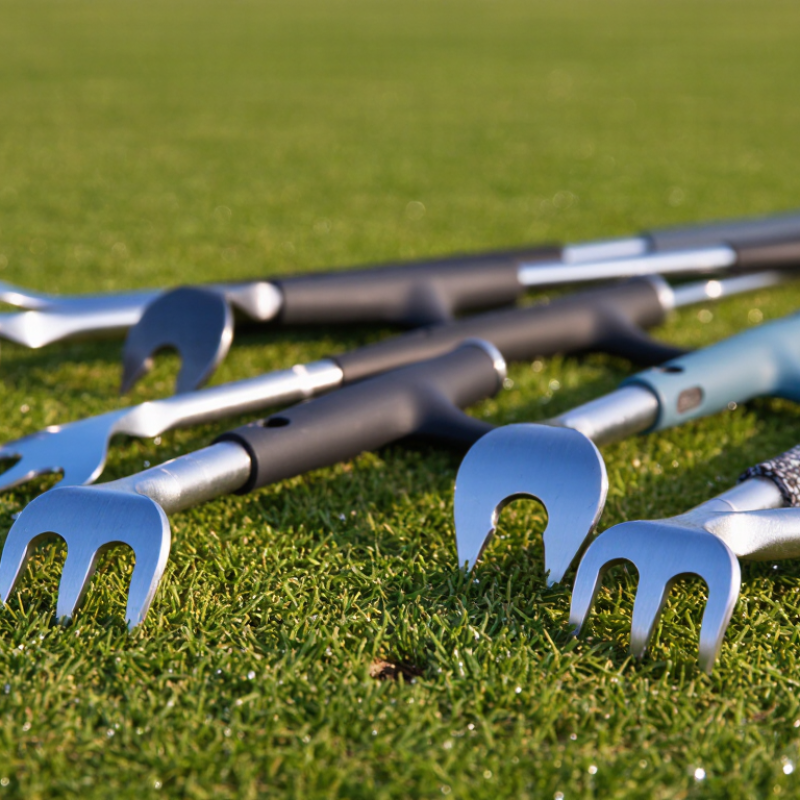
Top Golf Divot Tools for Golf Courses and Retailers

Golf Divot Tools Defined: Ball-Mark Repair on Putting Greens

Golf Divot Tools Defined: Ball-Mark Repair on Putting Greens

A golf divot tool is a small implement designed to repair ball marks on putting greens. A ball mark forms when a shot lands steeply and pushes turf below the surface. Left untreated, it can create a brown, uneven spot that affects putting lines and turf recovery. The tool usually has two narrow prongs and a comfortable grip. Simple equipment. Important job.

Effective repair depends on technique, not force. Insert the prongs beside the damaged area, then gently push turf toward the center. Work around the mark instead of lifting the soil upward.

Finish by tapping the surface with your putter or shoe. The repaired area should sit level with the surrounding grass.

Pulling the prongs outward can tear roots and enlarge the damage.

Golf course teams often keep tools near practice greens, maintenance vehicles, and starter stations. Retailers should consider tools with corrosion-resistant materials, secure grips, and shapes that fit different hand sizes. A clear instruction card can prevent careless repairs. Even experienced players sometimes use too much pressure. I have seen clean-looking marks reopen after poor handling. That small mistake deserves attention. A reliable divot tool supports faster turf recovery, smoother greens, and better playing conditions for everyone.

USGA Rule 13.1c: Legal Ball-Mark Repair and Turf-Care Practice

Top Golf Divot Tools for Golf Courses and Retailers

USGA Rule 13.1c allows golfers to repair damage on the putting green without penalty. This includes ball marks, shoe damage, animal scratches, and embedded objects. A properly designed divot tool helps restore the surface without tearing healthy turf. Use it gently around the mark, then press the center level with the surrounding green.

Small details matter. Pulling the edges upward can damage roots and leave a raised scar. Pushing turf toward the center usually creates a cleaner repair. The goal is a smooth surface, not a deep hole filled with loose soil. Course staff should inspect repaired areas during daily maintenance and replace tools that bend or develop sharp edges.

The rule does not allow players to correct every imperfection. Natural wear, aeration holes, disease damage, and ordinary surface irregularities are different. Divot tools also belong mainly on putting greens; fairway divots require separate turf-care methods. Retailers should explain this distinction clearly. In my experience, many players repair ball marks too quickly and too aggressively. I have done it myself. A slower motion often protects more grass and leaves less visible damage. Tools with comfortable grips, durable metal, and rounded repair points support consistent use across busy facilities. The best design is not always the most complicated. Reliability matters more.

Course Planning: Divot-Tool Coverage Across 18-Hole Operations

An 18-hole course needs a divot-tool plan, not a random box near the first tee. The National Golf Foundation reported approximately 531 million rounds played in the United States during 2023. That volume creates repeated wear around tees, fairways, and practice areas.

GCSAA’s Golf Course Environmental Profile places maintained turf on a typical 18-hole facility at roughly 100 acres, although layouts differ significantly. Coverage should follow traffic, not simply hole numbers. Place tools at every tee complex, near high-use fairway landing zones, and beside practice targets. A par-three course may need more tee-side coverage than a long par-five course. Small details matter. A visible tool station beside a cart path can prevent unnecessary walking and improve participation.

For course managers, calculate inventory by usage zone. One tool station for every two or three busy tee areas can support regular play, while practice facilities may require dedicated supplies. Retailers can package tools by operational scale, such as nine-hole, 18-hole, and tournament-use quantities. The numbers are only a starting point. Staff observations should refine them weekly.

A practical warning: golfers do not always return tools correctly. Some disappear. Others break after heavy use. A monthly count, paired with turf inspections, reveals gaps more accurately than purchasing records. The plan may need revision after wet weather, member events, or a busy weekend.

Product Comparison: Two-Prong, Three-Prong, and Sand-Fill Designs

Golf facilities need divot tools that match traffic, turf, and maintenance routines. The National Golf Foundation reported approximately 531 million rounds played in the United States during 2023. More rounds mean more pitch marks, damaged turf, and pressure on repair crews. The R&A’s Golf Around the World 2023 report also recorded about 66.6 million golfers worldwide. Small equipment choices now affect daily course presentation.

Two-prong tools offer controlled repair on compact greens. Their narrow tines lift the edges of a pitch mark without disturbing much surrounding turf. They suit golfers who value precision and compact retail packaging. Three-prong designs cover more surface area and can speed repairs during busy play. However, inexperienced users may overwork soft soil. That is not ideal. Course trials should measure recovery time, not just handling comfort.

Sand-fill designs support larger divot recovery on tees and fairway areas. A bottle or chamber delivers a sand-and-seed mixture directly into the scar, reducing loose material around the repair. The United States Golf Association’s agronomy guidance emphasizes matching repair practices with turf species, soil, and growing conditions. That makes a universal refill formula unrealistic. Retailers should show application limits clearly. Managers should also test flow consistency, cap durability, and grip performance with wet gloves. A tool can look efficient but still waste mix or frustrate players.

Top Golf Divot Tools for Golf Courses and Retailers

Product Comparison: Two-Prong, Three-Prong, and Sand-Fill Designs

Two-prong and three-prong tools are designed to repair ball marks by lifting and repositioning turf around the damaged area. Sand-fill designs use a built-in reservoir to distribute sand or seed mix into divots and are commonly selected when filling material is preferred over prong-based repair. The chart shows the defining physical features of each design category rather than brand-specific performance claims.

Retail Demand: NGF’s 25.6 Million U.S. On-Course Golfers in 2023

Top Golf Divot Tools for Golf Courses and Retailers

NGF reported 25.6 million U.S. on-course golfers in 2023. That figure signals strong, practical demand for golf accessories. Divot tools serve every course, from busy public layouts to private clubs. A reliable tool should repair ball marks quickly without bending in cold weather. Course staff often prefer durable metal or reinforced materials. Retailers can stock compact designs near gloves, tees, and scorecard holders. Visibility matters. Golfers usually remember useful items placed at checkout.

Tips: Test the tool on firm and soft turf. Check whether the prongs enter cleanly. Avoid sharp edges that may damage pockets or hands. Offer several price points, but do not confuse low price with value. A simple display card can explain correct ball-mark repair in seconds.

In my experience, golfers choose tools that feel balanced and easy to carry. Some decorative designs look attractive but become uncomfortable after eighteen holes. That detail is easy to miss. Retail buyers should also inspect hinge strength, grip texture, and packaging durability. Course operators may need larger quantities for starter desks and maintenance teams. The 25.6 million-player market is broad, yet purchasing habits differ by region and course type. Weather, turf condition, and customer expectations can change quickly. No product fits every golfer. Feedback from staff and players remains essential, even when the first sales results look promising.

Top Golf Divot Tools for Golf Courses and Retailers - Retail Demand: NGF’s 25.6 Million U.S. On-Course Golfers in 2023

Data Dimension 2023 Value Unit Retail and Course Planning Relevance Calculation or Source Basis
U.S. on-course golfers 25.6 million Golfers Represents the addressable participation base for golf-course accessories, including divot-repair tools. Reported 2023 figure referenced in the supplied title.
Equivalent golfer units per 1% of the addressable base 256,000 Golfers Useful benchmark for evaluating a small share of the total on-course golfer population. 25.6 million × 1%.
Equivalent golfer units per 5% of the addressable base 1.28 million Golfers Provides a mid-range planning benchmark for seasonal assortment and replenishment discussions. 25.6 million × 5%.
Equivalent golfer units per 10% of the addressable base 2.56 million Golfers Shows the scale represented by a ten-percent participation-based planning benchmark. 25.6 million × 10%.
Equivalent golfer units per 25% of the addressable base 6.40 million Golfers Can be used as a broader category-sizing reference for multi-channel golf accessory planning. 25.6 million × 25%.
Illustrative tool-per-golfer coverage at 1 tool per golfer 25.6 million Tools Illustrative upper-bound coverage quantity; it is not a reported sales figure or forecast. 25.6 million golfers × 1 tool.
Illustrative tool-per-golfer coverage at 0.5 tool per golfer 12.8 million Tools Illustrative replacement or partial-ownership planning quantity for assortment analysis. 25.6 million golfers × 0.5 tool.
Illustrative tool-per-golfer coverage at 0.25 tool per golfer 6.4 million Tools Illustrative conservative planning quantity for evaluating category potential without assuming universal ownership. 25.6 million golfers × 0.25 tool.
Core product function Repairing ball marks on putting greens Use case Supports product descriptions, point-of-sale education, and course-maintenance messaging. Standard purpose of a golf divot or ball-mark repair tool.
Primary sales environments Golf-course shops and retail channels Channel type Suitable for pro-shop merchandising, golf specialty retail, sporting-goods retail, and online accessory assortments. Channel classification based on the product’s golf-accessory use case.

Note: The 25.6 million figure is the supplied 2023 U.S. on-course golfer statistic. All percentage and tool-coverage quantities are transparent mathematical calculations or clearly labeled illustrative planning scenarios, not reported sales, shipment, or market-share data.