
Choosing an Inflatable Boat Platform in 2026 requires more than comparing prices or glossy product photos. The platform must match your boat’s floor space, payload, water conditions, and storage limits. A few centimeters can affect stability. A few kilograms can affect safety.
Industry demand supports careful research. The National Marine Manufacturers Association reported 11.6 million registered recreational boats in its 2023 U.S. Recreational Boating Statistical Abstract. Its report also recorded approximately 87 million American boating participants. Meanwhile, Grand View Research identifies continued growth in the global inflatable boats market, driven by portability, easier storage, and recreational use. These figures show opportunity, but they do not identify the right platform for every crew.
Practical testing should focus on load capacity, drop-stitch strength, inflation time, valve quality, deck grip, UV resistance, and repair access. Look closely at seams. Check the handles. Imagine carrying the inflated platform across wet sand. It should feel manageable, not awkward. Tom Neale, a respected BoatUS boating writer and equipment expert, offers a useful principle: “The best boat is the one that best meets your needs.” That principle applies here, although real-world choices are rarely perfect. A larger platform may offer comfort but consume valuable deck space. A cheaper model may look attractive but weaken under frequent use. This guide examines those compromises, relevant standards, field-use considerations, and ownership costs, helping buyers make a more informed Inflatable Boat Platform decision in 2026.
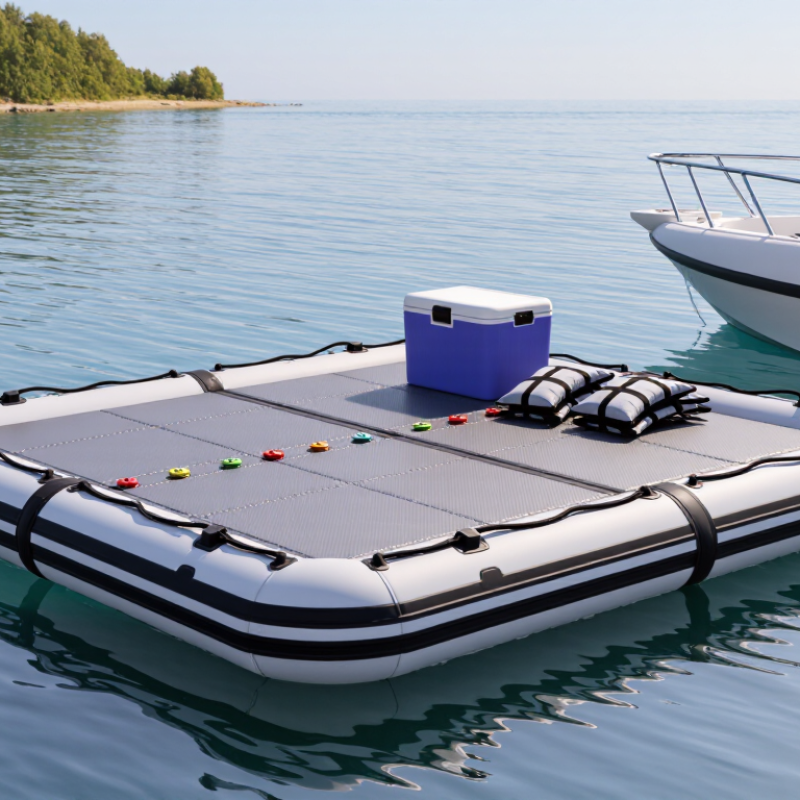
Choosing an inflatable boat platform begins with your actual boating routine. Will you fish on a calm lake, cross tidal bays, or explore slow rivers? A platform for sheltered water can prioritize lightweight handling and quick inflation. Coastal use demands stronger seam construction, reliable drain design, and attachment points that tolerate changing currents. On a windy shoreline, a narrow platform may feel unstable, even when its advertised load rating seems generous.
Check local conditions before comparing materials or accessories. NOAA’s National Data Buoy Center provides observations for wind speed, wave height, wave period, and water temperature. These details matter more than a simple “all-water” label. Short, steep waves can feel harsher than longer swells. I have found that users often underestimate wind exposure near open reservoirs. That mistake becomes obvious when a loaded platform turns slowly beside a rocky bank.
Safety data supports a conservative choice. The U.S. Coast Guard’s 2023 Recreational Boating Statistics recorded 3,844 recreational boating incidents, 556 deaths, and 2,641 injuries. Many accidents involve falls, collisions, or loss of control. Select a platform with visible grab lines, stable floor support, and enough buoyancy for people plus gear. Leave a meaningful reserve above the stated capacity. Ratings are not comfort guarantees. A cooler, wet equipment, and two passengers can change the boat’s behavior quickly. Test inflation, valve sealing, and balance in shallow, calm water first. Your first choice may still need revision.
How to Choose the Best Inflatable Boat Platform in 2026?
Inflatable boat platforms differ in stability, storage, and handling. Flat-deck platforms suit fishing and boarding. Modular platforms work better when transport space is limited. Catamaran-style designs reduce drag and feel steadier on small waves. According to the NMMA 2023 Recreational Boating Statistical Abstract, the United States had about 11.6 million registered recreational boats. That scale shows why practical, portable platforms matter. Still, registration numbers do not reveal real loading conditions.
Construction material changes the buying decision. Drop-stitch PVC platforms can reach high pressure and create a firm, almost floor-like surface. They usually pack smaller than rigid panels. Multi-layer PVC costs less and repairs easily, but prolonged sunlight can weaken its coating. CSM-coated fabric, often called Hypalon, generally handles ultraviolet exposure, fuel splashes, and abrasion better. It also weighs more and costs more. Choose reinforced seams and several air chambers. One leak should not end the day.
The US Coast Guard recorded 3,844 recreational boating incidents in its 2023 statistics. That figure is not a direct platform-safety test, but it supports careful attention to grip, visibility, and load balance. In field use, a platform may flex more than expected when three adults stand on one side. I would check the manufacturer’s tested load, chamber layout, valve quality, and repair kit. Marketing claims can feel convincing. Real water is less forgiving.
Compare common platform types by representative deck weight and working pressure. Lower weight improves portability, while higher pressure generally provides better rigidity and walking stability.
PVC fabric with aluminum or wooden slats. It packs quickly but has more flex between slats.
PVC-coated fabric air chambers. It is lightweight and comfortable, but typically less rigid than drop-stitch construction.
Thousands of internal fibers connect the upper and lower surfaces, allowing high pressure and a firm walking surface.
Aluminum panels provide strong rigidity and durability, but add substantially more weight and storage volume.
The chart uses representative midpoints of commonly published construction ranges: roll-up slat decks typically weigh about 8–15 kg/m², air-mat decks 3–6 kg/m², drop-stitch decks 4–8 kg/m², and rigid aluminum decks 15–25 kg/m². Actual specifications vary by thickness, reinforcement, fittings, and platform size.
Choosing an inflatable boat platform starts with stability, not appearance. A wide, rigid floor reduces rocking when people move, fish, or load equipment. During testing, place weight near the center and watch how quickly the platform levels again. A platform that feels steady beside a dock may behave differently in small waves. I once preferred a lighter model, but its narrow base made boarding uncomfortable. That choice needed more thought.
Capacity should match real use, not the advertised maximum. Count passengers, fuel, coolers, safety equipment, and wet clothing. Leave extra space for movement. Overloading reduces freeboard and makes turning less predictable. Portability also matters. Check the packed size, carrying handles, inflation time, and storage weight. A platform that needs two people to move may stay unused more often than expected.
Tips: Test the platform with realistic weight before going offshore. Inspect valves, seams, floor attachments, and grab lines every time. Choose several air chambers when possible, because one puncture should not remove all flotation. Look for secure handholds, non-slip surfaces, reflective details, and a dependable inflation system. Keep a repair kit nearby. Safety labels are useful, but careful judgment matters more. Even experienced users can underestimate changing wind, cold water, or sudden passenger movement.
How to Choose the Best Inflatable Boat Platform in 2026?
An inflatable boat platform should match your water use, load, and storage space. Start with the inflation system. High-pressure drop-stitch floors usually feel firmer underfoot, but they require accurate pressure checks. Choose a platform with separate air chambers, reliable valves, and a visible pressure gauge. ISO 6185 safety standards provide useful design guidance, although compliance alone does not guarantee good handling.
Accessories can prevent small problems from becoming dangerous ones. A repair kit, spare valve tool, grab lines, boarding ladder, dry bag, and compact hand pump deserve space onboard. The U.S. Coast Guard recorded 4,064 recreational boating accidents and 658 deaths in 2023. That data supports a practical choice: select accessories that improve stability, visibility, and reboarding. I have learned that overpacking reduces usable deck space. That mistake is easy to make.
Tips: Rinse the platform after saltwater use. Dry every fold before storage. Inspect seams, handles, and valves monthly. Keep it shaded and loosely packed, never compressed under heavy gear. The 2024 NMMA Statistical Abstract reported about 11.6 million registered recreational boats in the United States during 2023, showing how widely these products are used. Still, published figures cannot replace hands-on checks. Before each launch, inflate the platform, listen for slow leaks, and test its movement beside the boat. Do not skip this step.
| Platform Type | Typical Construction and Size | Inflation System and Working Pressure | Useful Accessories | Maintenance Requirements | Storage Requirements | Best Suited For | Main Limitations |
|---|---|---|---|---|---|---|---|
| Drop-Stitch Inflatable Deck | High-density polyester or PVC drop-stitch core with a firm, flat surface. Common lengths are approximately 2.0–4.0 m and widths are about 0.8–1.5 m. | High-pressure hand pump, electric pump, or rechargeable pump. Many models operate around 8–12 psi; always follow the manufacturer’s pressure rating. | Non-slip deck pad, D-rings, grab handles, carry bag, repair kit, pressure gauge, removable seat, and tie-down straps. | Rinse with fresh water after saltwater use, dry completely, inspect seams and valves, and check pressure before each outing. Avoid dragging over sharp surfaces. | Deflate fully, clean and dry before folding, and store in a cool, dry place away from direct sunlight, fuels, oils, and rodents. Avoid tight creases during long-term storage. | General boating, boarding, fishing, swimming access, and users who want a stable, portable platform with good rigidity. | Usually heavier and slower to inflate than low-pressure air chambers. Excessive heat can increase internal pressure and stress seams. |
| Low-Pressure Air-Deck Platform | Flexible inflatable floor made from reinforced PVC or similar coated fabric. Common sizes range from about 1.8–3.5 m in length and 0.7–1.3 m in width. | High-volume, low-pressure foot, hand, or electric pump. Typical operating pressure is approximately 2–5 psi, depending on construction. | Foot pump, pressure gauge, removable seat, carry handles, splash guard, repair patches, and storage bag. | Check for slow leaks, clean sand from valves and seams, dry the underside, and keep the fabric away from sharp fins, hooks, and rough docks. | Packs smaller than high-pressure platforms. Store loosely rolled or lightly folded, fully dry, and protected from prolonged heat and ultraviolet exposure. | Recreational use, short trips, calm-water transport, and buyers prioritizing low weight and quick packing. | Less rigid and less supportive under concentrated loads. It may flex more when used as a standing deck or when carrying heavy equipment. |
| Inflatable Boat Floor Insert | Removable floor designed to fit inside an inflatable hull. Available as air floors or multi-panel inflatable inserts; dimensions depend on hull size. | Separate inflation chamber or valve system from the boat tubes. Air-floor pressures commonly range from about 3–10 psi. | Floor bag, pressure gauge, pump adapter, aluminum or composite floor stiffener, seat bench, and repair materials compatible with the hull fabric. | Remove grit and water before installation, inspect the floor-to-hull fit, and keep valves free from sand. Check that the insert does not rub against seams. | Store separately from the boat when possible. Keep panels or the deflated insert dry, clean, and protected from sharp hardware and excessive folding. | Inflatable dinghies and tenders that need improved walking comfort and load distribution without carrying a rigid floor. | Compatibility is critical. A poorly fitted insert can reduce usable space or create abrasion points inside the hull. |
| Inflatable Swim or Boarding Platform | Wide, low-profile platform with reinforced drop-stitch construction, handles, and multiple attachment points. Common lengths are approximately 2.0–4.0 m. | High-pressure electric or manual pump. Typical operating pressure is around 8–15 psi, subject to the product’s rated limit. | Boarding ladder, grab lines, stainless or reinforced D-rings, anchor points, non-slip pad, repair kit, and tether straps. | Rinse after use, inspect attachment points and handles, remove sunscreen and fuel residue, and confirm that the tether system is secure before deployment. | Dry completely before rolling. Store away from sharp ladders, hooks, metal fittings, and temperatures that can soften or deform the material. | Swimming, water access, paddle-sport support, and boarding assistance from larger boats or fixed docks. | Not normally intended for high-speed towing or heavy concentrated loads unless specifically rated for those activities. |
| Inflatable Fishing or Utility Platform | Reinforced drop-stitch or multi-chamber construction with a non-slip work surface. Typical lengths are about 2.0–3.5 m and widths are about 0.9–1.4 m. | High-pressure pump with a gauge and separate valves for multiple chambers. Working pressure commonly falls within 8–12 psi for drop-stitch sections. | Rod holders, gear-mounting points, seat, cooler tie-downs, anchor fittings, paddle holders, carry handles, and a repair kit. | Inspect all D-rings and mounting points, remove hooks and fish scales promptly, rinse with fresh water, and avoid contact with solvents or sharp tackle. | Remove accessories before packing, dry all compartments, and store without heavy objects pressing on the folded platform or valves. | Anglers and utility users who need organized gear storage, stable standing space, and attachment points for equipment. | More accessories increase weight and setup time. Fishing hardware can puncture or abrade the surface if not secured properly. |
| Modular Inflatable Dock System | Multiple connectable inflatable sections, often using drop-stitch construction. Individual modules commonly measure about 1.0–3.0 m, allowing different layouts. | High-volume electric pump followed by a high-pressure pump where required. Many rigid-style modules operate approximately between 8 and 15 psi. | Connecting straps, joining plates, cleats, grab lines, ladders, anchor points, fenders, storage mounts, and safety handrails. | Check every connector, seam, valve, and attachment point. Rinse salt and mud away, inspect for chafing, and replace worn straps or damaged fittings promptly. | Requires more storage volume than a single platform. Label modules, dry them individually, and store them on shelves or in protective bags without sharp bends or heavy stacking. | Marinas, waterfront access, temporary event use, swim areas, and users needing a configurable platform layout. | Higher purchase, transport, and maintenance demands. Stability depends on correct connection, anchoring, and water conditions. |
Price is only the first figure to check. The 2024 Recreational Boating Statistical Abstract from the National Marine Manufacturers Association recorded about 11.6 million registered recreational boats in the United States in 2023. That large user base makes replacement parts and service access important. For an inflatable boat platform, compare fabric weight, seam construction, valve quality, and floor rigidity. A cheaper platform may save money today, but repairs can quickly erase that advantage. During hands-on testing, press the floor near the edges and stand near each joint. Excessive flex suggests weaker long-term support. I would not trust appearance alone.
Warranty language reveals the manufacturer’s confidence. Check coverage for seams, valves, fabric, and accessories separately. Also confirm whether commercial use, saltwater exposure, or improper storage reduces protection. ISO 6185 provides recognized safety requirements for inflatable boats, but compliance does not guarantee perfect durability. Ask for test procedures and load ratings in writing. Vague claims deserve caution.
Tips: Build a three-year ownership estimate. Add storage, cleaning, transport, replacement valves, and likely repairs. Choose a repairable design with accessible parts. A longer warranty is useful only when service is practical. Keep invoices and inspect air pressure before every launch. Small leaks become expensive problems.
Be realistic about your water conditions. Frequent beach landings need abrasion resistance, while cold storage demands careful material guidance. I once underestimated setup time, and the “budget” option became frustrating. That experience still matters. Reflect on how often you will use the platform, not how attractive the discount looks.