How to Choose the Right Golf Irons for Your Skill Level and Playing Style
Choosing the right golf irons is a crucial step in elevating your game, as they play a significant role in your performance on the course. Understanding the various factors that influence the suitability of golf irons for different skill levels and playing styles is essential. Whether you are a beginner honing your skills or an advanced player looking to fine-tune your equipment, selecting the appropriate golf irons can lead to improved accuracy, consistency, and overall enjoyment of the game.
Golf irons come in a variety of designs, lofts, and materials, each tailored to meet the unique needs of players. Beginners may benefit from forgiving irons that offer greater distance and accuracy on mis-hits, while more experienced golfers might prefer clubs that provide better control and shot shaping capabilities. Assessing your own skill level and playing style is key to making an informed decision, as it ensures that your equipment complements your approach to the game.
In this guide, we will explore the essential aspects to consider when selecting golf irons, including shaft flexibility, clubhead design, and the importance of fitting. By understanding how these elements align with your personal strengths and weaknesses, you can choose the right golf irons that will enhance your performance and help you enjoy the sport even more.
Understanding Different Types of Golf Irons: A Comprehensive Overview
When selecting golf irons, it's crucial to understand the different types available to align them with your personal skill level and playing style. Irons are typically categorized based on their number, ranging from long irons (2-4) to mid irons (5-7) and short irons (8-PW). Long irons, characterized by their lower loft and longer shafts, are designed for experienced players who can consistently make contact for greater distance. Conversely, short irons provide higher loft and more control, making them suitable for beginners or those focusing on accuracy and precision around the greens.
In addition to the basic categories, players can choose between cavity back and blade irons. Cavity back irons are often favored by novices because they feature a perimeter-weighted design, offering a larger sweet spot and added forgiveness on off-center hits. Blade irons, on the other hand, are preferred by intermediate to advanced players who seek greater control and feedback on their shots. Understanding these distinctions is essential in making informed decisions that cater to your practice style, helping you improve your game and enjoy the sport more fully.
Assessing Your Skill Level: Choosing Irons for Beginners vs. Advanced Players
When choosing golf irons, recognizing your skill level is crucial for optimizing performance on the course. Beginners typically benefit from game-improvement irons, designed to offer more forgiveness. These clubs usually feature a larger sweet spot and a lower center of gravity, allowing novice players to achieve greater distance and accuracy. According to the USGA, approximately 80% of golfers are classified as high-handicap players, underscoring the demand for user-friendly iron options that promote confidence on each swing.
For advanced players, the focus shifts towards control and workability. These golfers often prefer players' irons, which have a thinner club face and a more compact design, enabling greater shot shaping and precision. Research from the National Golf Foundation indicates that lower handicap golfers prefer clubs that provide more feedback and allow for a higher level of customization. This distinction reinforces the idea that as proficiency increases, the specification of irons should be tailored to suit individual techniques and course strategies.
Tips: When selecting irons, take the time to assess not only your current skill level but also your playing style. A club fitting session can be invaluable, as it allows for the evaluation of swing mechanics and personal preferences. Additionally, always consider trying out multiple irons at a driving range to gain firsthand experience of how different designs affect your game, ensuring you make an informed choice that will help elevate your performance.
How to Choose the Right Golf Irons for Your Skill Level and Playing Style
| Skill Level |
Player Type |
Iron Type |
Key Features |
Recommended Shaft |
| Beginner |
High Handicap |
Super Game Improvement |
Larger clubface, forgiving design |
Graphite, Regular Flex |
| Intermediate |
Mid Handicap |
Game Improvement |
Balance of distance and control |
Steel, Regular or Stiff Flex |
| Advanced |
Low Handicap |
Players Irons |
Precision and shot-making ability |
Steel, Stiff or X-Stiff Flex |
Evaluating Club Specifications: Loft, Shaft Flex, and Weight Considerations
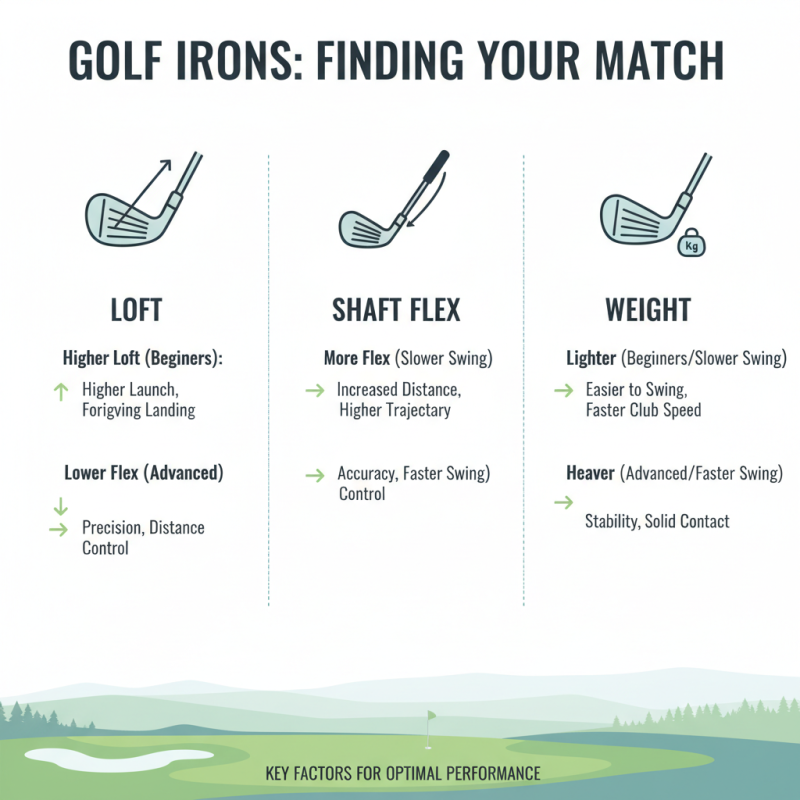
When selecting the perfect golf irons, understanding the specifications of each club is crucial to match your skill level and playing style. Key factors such as loft, shaft flex, and weight can significantly impact your performance on the course. Loft refers to the angle of the clubface, which influences the trajectory and distance of the shot. Higher lofted clubs are suitable for beginners, as they provide a higher launch and more forgiving landing, while lower lofts benefit more advanced players who can generate their own loft and require precision.
Shaft flex, another essential consideration, determines how much the club shaft bends during a swing. Players with slower swing speeds typically benefit from more flexible shafts, which help achieve better distance and accuracy. Conversely, those with faster swing speeds often prefer stiffer shafts for improved control and consistency. Finally, the weight of the club can greatly affect swing dynamics. Lighter clubs can increase swing speed for players seeking distance, while heavier clubs tend to provide more stability and control, which may appeal to those with a more established swing technique. By evaluating these specifications carefully, golfers can find the right set of irons that aligns with their unique abilities and preferences.
Identifying Your Playing Style: Selecting Irons for Accuracy vs. Distance
When selecting golf irons, understanding your playing style is crucial to optimize your performance on the course. Golfers typically fall into two categories:
those who prioritize accuracy and those who favor distance.
According to a 2021 survey conducted by the National Golf Foundation, 67% of amateur golfers rank accuracy as their most critical factor when choosing their equipment, particularly for iron play.
This highlights the importance of selecting irons that provide a larger clubface and improved forgiveness on off-center hits,
which can significantly enhance overall shot precision.
On the other hand, players who emphasize distance might lean towards design characteristics such as a lower center of gravity and a larger sweet spot.
A study published in the Journal of Sports Sciences in 2020 found that golfers focused on distance can benefit from "game improvement" irons,
which typically allow for higher launch angles and greater ball speeds. These players may sacrifice a bit of accuracy for the added yardage but can find balance with clubs that still offer decent forgiveness.
By examining individual performance metrics and understanding personal priorities in play style, golfers can make informed decisions that align with their gameplay,
leading to improved outcomes on the course.
Analyzing Industry Trends: Recent Data on Golf Iron Performance and Preferences
Recent trends in the golf industry emphasize the evolving preferences of players when it comes to selecting golf irons. Data analysis reveals that golfers are increasingly favoring irons that combine distance with forgiveness, reflecting a shift towards maximizing performance while maintaining ease of use. This trend is particularly evident among mid to high handicappers, who seek clubs that help improve their game without sacrificing feel or control. The split between traditional and modern designs is also noticeable; many players now lean towards game-improvement irons that offer a larger sweet spot and enhanced launch angles, making them more accessible to a broader range of skill levels.
In addition to performance characteristics, aesthetics and customizability have become significant factors driving purchasing decisions. Today's golfers are more inclined to choose irons that complement their personal style and provide options for customization to suit their unique playing style. Furthermore, the data indicates a growing interest in technological advancements such as aerodynamic club shapes and improved materials, which not only boost performance but also contribute to a more appealing overall design. As manufacturers continue to innovate, understanding these preferences will be crucial for players looking to select the right set of irons that align with their abilities and aspirations on the course.